The Fertility Care Decoder: Evaluating Clinic Data, Lab Standards, and True Costs
Introduction
Starting fertility research online can feel overwhelming within minutes. A search window quickly fills with technical acronyms, complex price sheets, clinic promises, and pages of forum discussions. Because family planning carries significant emotional and financial weight, finding clear, grounded guidance is essential.
Online health research works best when treated as an informational foundation rather than a substitute for medical advice. Learning how to review procedures, evaluate facilities, interpret clinical data, and assess true expenses allows you to walk into a consultation prepared to ask meaningful questions.
Exploring Modern Family-Building Pathways
Fertility medicine encompasses an array of clinical approaches designed to address distinct reproductive challenges. Understanding available fertility treatment options gives patients a clearer sense of which clinical paths match their medical history and family-building goals.
Care typically begins with thorough diagnostic evaluations for all partners involved. These baseline assessments include blood hormone panels, ovarian reserve screenings, pelvic ultrasound imaging, and comprehensive semen analyses.
For some individuals, non-surgical interventions represent the first phase of care. Ovulation induction uses oral or injectable medications to stimulate follicle development, often paired with timed intercourse. Intrauterine insemination (IUI) involves placing washed, concentrated sperm directly into the uterus around the time of ovulation.
When simpler methods are unsuitable or unsuccessful, advanced reproductive technologies provide alternatives. These procedures involve retrieving mature eggs from the ovaries, fertilizing them in a laboratory setting, and transferring the resulting embryo into the uterus. Preserving gametes for future family planning has also become a standard, proactive option for individuals delaying conception for personal or medical reasons.
Examining In Vitro Fertilization and Microinjection
Patients exploring laboratory-assisted conception frequently encounter two closely related procedures. Understanding ICSI vs IVF helps clarify how embryologists assist the fertilization process under different clinical circumstances.
Standard in vitro fertilization (IVF) involves placing an egg into a specialized culture dish surrounded by thousands of motile sperm. The sperm must naturally penetrate the outer layer of the egg to achieve fertilization. This traditional method relies on adequate sperm count, motility, and normal morphology.
Intracytoplasmic sperm injection (ICSI) is a specialized laboratory technique where an embryologist selects a single, healthy sperm and injects it directly into the cytoplasm of a mature egg using a microscopic needle. ICSI is commonly recommended when severe male-factor challenges exist, such as low sperm count, poor motility, or abnormal shape. It may also be utilized if previous traditional cycles yielded low fertilization rates, or when utilizing surgically retrieved sperm or frozen eggs. While both methods culminate in embryo culture and transfer, the choice between them depends entirely on diagnostic findings and clinical indicators.
Evaluating Prospective Care Facilities
Choosing a clinical team is one of the most critical decisions in reproductive care. Learning how to systematically compare IVF clinics ensures you assess facilities on operational quality, medical expertise, and transparency rather than marketing claims alone.
Key factors to examine during your review include:
- Physician Qualifications and Staffing: Verify that physicians hold subspecialty board certifications in reproductive endocrinology and infertility. Check whether nurses and embryologists have specific experience in advanced reproductive techniques.
- Laboratory Quality and Accreditations: The embryology laboratory is the core of any center. Look for formal accreditation from recognized healthcare oversight bodies, rigorous air filtration systems, and modern cryopreservation technology.
- Diagnostic Capabilities: Review whether the center handles specialized diagnostics in-house—such as preimplantation genetic testing coordination or advanced hysteroscopy—or refers them out, which may alter your scheduling timeline.
- Pricing Transparency: Request itemized documentation covering package inclusions and excluded fees. Clear communication regarding potential out-of-pocket expenses indicates administrative integrity.
- Regulatory Oversight: Ensure the facility complies with national regulatory frameworks and reports data to official monitoring registries.
Independent informational platforms like IVFHospitalsNow.com can serve as helpful starting points during this research phase, allowing individuals to explore provider directories, review clinical capabilities, and read educational overviews before scheduling consultations.
The Practical Role of Geographic Proximity
When starting their search, many individuals instinctively look for IVF clinics near me to identify convenient care centers. Physical location is an understandable priority because assisted reproduction requires frequent, time-sensitive visits.
A typical treatment cycle involves regular clinic visits over a span of two to three weeks for blood draws and transvaginal ultrasound monitoring. Living near a facility minimizes travel fatigue, reduces time missed from work, and makes early-morning monitoring appointments manageable.
However, convenience should never be the sole determining factor. A nearby facility may lack the specialized laboratory infrastructure required for complex cases, or its medical team may have limited experience with conditions like severe endometriosis, recurrent pregnancy loss, or advanced maternal age. Balancing proximity against clinical capability ensures that convenience does not compromise care quality.
Understanding the Components of Treatment Expenses
Navigating reproductive care requires financial planning, as public healthcare systems and private insurance policies often offer varied or limited coverage. Understanding IVF treatment cost involves looking beyond basic procedural fees to capture every component of a complete treatment cycle.
Total expenses are rarely represented by a single figure. An accurate budget accounts for multiple distinct phases:
- Preliminary Diagnostics: Hormone panels, genetic carrier screenings, infectious disease panels, and imaging procedures required before stimulation begins.
- Ovarian Stimulation Medications: Injectable medications represent a significant portion of overall spending. Dosages are customized based on individual ovarian reserve markers and response rates, meaning pharmaceutical costs fluctuate widely between patients.
- Cycle Monitoring: Regular ultrasound evaluations and laboratory blood tests conducted to track follicular growth and prevent complications.
- Surgical and Anesthesia Services: The operating room and professional anesthesia fees associated with the transvaginal egg retrieval procedure.
- Embryology Laboratory Services: Culture media, fertilization techniques, extended blastocyst culture, and embryo biopsy procedures.
- Cryopreservation and Storage: Freezing surplus embryos and ongoing annual storage fees.
- Transfer Procedures: The preparatory medications, ultrasound guidance, and clinical services associated with an embryo transfer.
Always ask financial coordinators for an itemized estimate outlining which elements are included in a standard cycle fee and which require separate payment.
Navigating Cross-Border Reproductive Healthcare
Traveling abroad for medical care has gained attention among individuals exploring alternative treatment routes. Researching IVF treatment abroad requires careful evaluation of medical, practical, and legal details rather than simply looking at travel brochures.
People explore international care for various reasons, including access to specific donor arrangements, regulatory variations, or lower service fees in certain healthcare markets. However, traveling for assisted reproduction introduces distinct logistical challenges:
- Regulatory Environments: Legal frameworks governing assisted reproduction vary considerably across borders. Regulations dictate donor anonymity rules, eligibility for single parents or same-sex couples, preimplantation genetic testing permissions, and the number of embryos permitted for transfer.
- Medical Communication: Language differences can lead to misunderstandings regarding treatment instructions or medication schedules. Ensure the international clinic provides dedicated, fluent coordinators and written treatment plans in your primary language.
- Pre-Travel Coordination: Clarify whether initial blood tests, ultrasound scans, and stimulation cycles can be monitored by a local doctor before you travel, reducing the time you must spend abroad.
- Continuity of Care: Establish a clear protocol for post-transfer monitoring once you return home. Your local primary physician or gynecologist should be willing to manage early pregnancy monitoring, hormonal support, and any unexpected complications.
Evaluating International Expense Variations
When reviewing overseas options, prospective patients frequently discover significant differences in standard package pricing. Understanding how IVF cost by country is calculated prevents misleading comparisons and hidden expenses.
A lower base price in an overseas medical system often reflects lower local labor costs, administrative overhead, and regulatory expenses. However, comparing two figures directly across different healthcare systems rarely provides the full financial picture.
To compare expenses accurately, you must assemble a comprehensive budget that includes:
- Medication Pricing: Prescriptions purchased abroad may carry different brand names, formulations, or pricing structures than those at home.
- Travel and Housing: Flights, ground transportation, extended hotel or apartment stays, and daily living expenses for several weeks.
- Ancillary Laboratory Fees: Specialized procedures such as ICSI, extended culture, or genetic testing are frequently billed as separate line items rather than inclusive packages.
- Emergency Contingency Funds: Financial reserves for flight rescheduling fees, extra nights of accommodation if stimulation takes longer than expected, or medical care for cycle complications.
Educational directories like IVFHospitalsNow.com can help individuals explore global provider landscapes and understand general regional healthcare structures during their preliminary research.
Interpreting Clinical Outcome Data
Reviewing published clinical performance is an important step when evaluating facilities, but it requires analytical caution. Learning how to assess IVF success rates responsibly helps prevent unrealistic expectations based on simplified marketing figures.
Clinical results are influenced by numerous patient-specific and methodological variables:
- Patient Age and Ovarian Reserve: Maternal age is the single most significant factor influencing egg quality and treatment outcomes. A facility that treats older demographics or complex diagnoses may report lower overall numbers than a clinic that primarily accepts younger patients with straightforward indications.
- Reporting Definitions: Clarify whether the published figure refers to positive pregnancy tests (biochemical pregnancy), ultrasound-confirmed heartbeats (clinical pregnancy), or actual live-birth deliveries per cycle initiated. Live birth rates per embryo transfer represent the most reliable clinical benchmark.
- Per-Cycle vs. Cumulative Figures: Per-cycle metrics reflect the likelihood of success from a single retrieval and transfer. Cumulative figures estimate the chance of success across multiple cycles, often incorporating frozen embryo transfers over several months or years.
- Official Registry Reporting: In regions with strict regulatory frameworks, reputable centers submit their outcome data directly to public health authorities or national professional societies that verify and standardize reporting methodologies.
Never view published outcome percentages as a guarantee of personal success. Your individual prognosis depends on specific medical diagnoses that can only be evaluated through clinical consultation.
Financial and Logistical Considerations for Gamete Preservation
Oocyte cryopreservation offers individuals an established method for preserving reproductive options for the future. Understanding egg freezing cost requires evaluating both the immediate procedural fees and the ongoing maintenance expenses associated with long-term storage.
The initial phase includes baseline ovarian reserve testing, ovarian stimulation medications, regular monitoring visits, transvaginal egg retrieval, and the laboratory vitrification process. Once the eggs are safely frozen, annual storage fees apply for as long as the specimens remain cryopreserved.
Additionally, financial planning must account for future utilization steps. If you decide to use the frozen eggs later, you will incur fees for thawing, fertilization via ICSI, embryo culture, and the subsequent embryo transfer cycle. Exploring comprehensive educational platforms like IVFHospitalsNow.com allows individuals to review how preservation procedures work, identify prospective storage centers, and prepare for both immediate and future expenses.
Verifying Online Medical Information
Because digital healthcare content varies widely in reliability, applying critical evaluation criteria protects you from inaccurate claims, outdated science, and disguised promotional messaging.
When reviewing fertility resources online, look for the following quality indicators:
- Author Credentials and Medical Review: Check whether articles are written or formally reviewed by qualified reproductive endocrinologists, obstetricians, or certified embryologists.
- Publication and Revision Dates: Reproductive medicine evolves rapidly. Ensure that clinical protocols, laboratory methodologies, and regulatory discussions reflect recent updates.
- Reference to Peer-Reviewed Literature: High-quality resources cite published medical studies, established clinical guidelines, and data from recognized reproductive societies rather than relying on anonymous opinions.
- Balanced Tone: Trustworthy material discusses potential risks, procedural limitations, and emotional considerations alongside potential benefits, avoiding sensationalized language or promises of guaranteed outcomes.
- Clear Disclaimers: Responsible educational sites explicitly state that their content is intended for informational purposes and cannot substitute for personalized clinical evaluation.
A Structured Approach to Patient Research
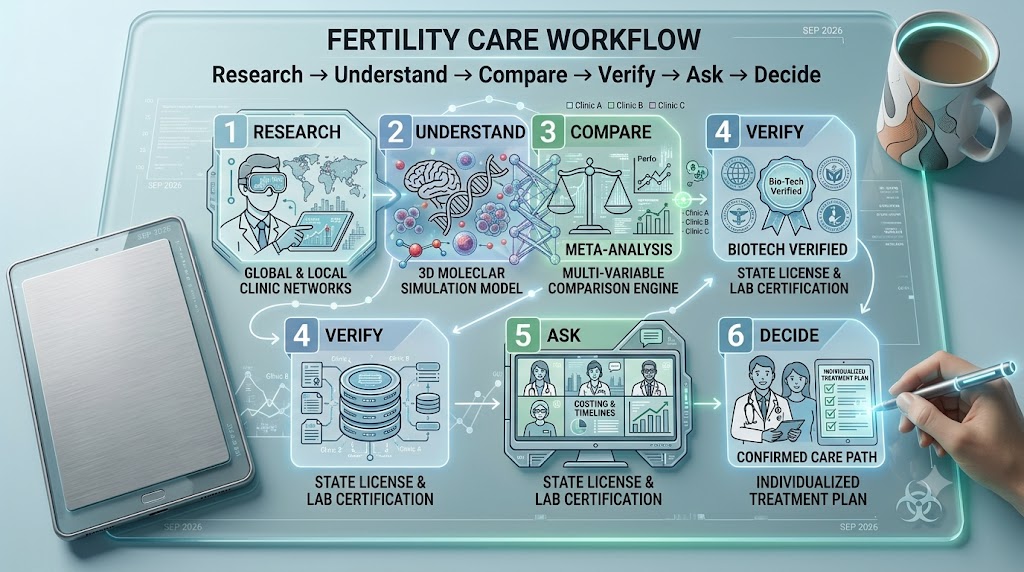
Approaching fertility research systematically prevents decision fatigue and keeps your medical priorities organized. Following a stepwise research workflow brings clarity to the process:
- Research: Read foundational educational resources to understand common diagnoses, treatment pathways, and standard terminology.
- Understand: Clarify your personal medical history, family-building timeline, and financial parameters.
- Compare: Review multiple prospective facilities, assessing their clinical capabilities, laboratory credentials, communication practices, and pricing structures.
- Verify: Cross-check clinic claims against regulatory registries, verify physician board certifications, and confirm that the facility follows evidence-based standards.
- Ask: Schedule initial consultations armed with specific, itemized questions regarding protocols, risks, and financial policies.
- Decide: Choose a medical team that demonstrates clinical excellence, transparent communication, and genuine alignment with your personal care values.
Key Questions to Discuss During a Clinic Consultation
Before committing to a specific medical center, prepare a targeted list of questions to discuss during your introductory appointment:
- What specific diagnostic evaluations do you recommend before finalizing a treatment protocol?
- Are all monitoring ultrasounds and blood draws handled by physicians, or by specialized nursing staff?
- What is the setup and accreditation status of your embryology laboratory?
- Can you provide an itemized fee sheet detailing what is included in the base cycle cost versus potential add-on fees?
- What are your standard policies regarding the number of embryos transferred in a single cycle?
- How does your team handle communication and urgent medical questions outside of standard office hours?
- What emotional support resources, counseling services, or patient coordinators are available to help navigate the treatment cycle?
Frequently Asked Questions
How should I compare IVF clinics? Focus on physician board certifications, embryology laboratory accreditations, transparency in pricing, range of diagnostic services, and patient communication standards. Reviewing official registry reports provides standardized insight into clinic volume and patient demographics. Independent educational resources can help organize your preliminary research before scheduling formal consultations.
What factors affect IVF treatment cost? Overall expenses are determined by required pre-cycle diagnostics, customized stimulation medication dosages, laboratory procedures like ICSI or genetic screening, embryo cryopreservation, annual storage fees, and subsequent transfer procedures. Geographic location and individual clinical protocols also influence final expenses.
How should I interpret IVF success rates? Review outcome figures through the lens of patient age, specific diagnoses, and whether data reflects per-cycle or cumulative results. Look for live birth rates rather than simple biochemical pregnancy rates, and verify whether the clinic reports its findings to standardized national registries.
What should I consider before choosing IVF treatment abroad? Key considerations include destination legal frameworks, donor regulations, language barriers, cross-border medication logistics, pre-travel monitoring arrangements, travel and housing expenses, and establishing a plan for continuous medical care once you return home.
How can IVF cost by country be compared fairly? Assemble a complete budget that accounts for base treatment packages, required medications, supplemental laboratory techniques, flights, lodging, local transportation, and emergency financial reserves. A lower procedure cost abroad does not automatically translate to a lower total investment.
What is the difference between ICSI vs IVF? Standard IVF places an egg in a dish with thousands of sperm to allow natural penetration and fertilization. ICSI involves an embryologist directly injecting a single selected sperm into a mature egg. ICSI is primarily utilized for male-factor fertility challenges, previous low fertilization rates, or specific laboratory protocols.
Conclusion
Researching reproductive care online requires patience, critical evaluation, and a commitment to verifying information through credible sources. By systematically exploring treatment options, understanding procedural distinctions, and assessing facilities on clinical transparency rather than marketing claims, prospective patients can make confident decisions.
Platforms such as IVFHospitalsNow.com provide helpful educational directories and informational overviews to support the research process. Ultimately, your digital research should serve as a practical springboard for informed, collaborative conversations with qualified reproductive healthcare specialists who can tailor care to your individual needs.